Is Housing Still the American Dream?
Membership required
Membership is now required to use this feature. To learn more:
View Membership Benefits
"No man who owns his own house and lot can be a Communist. He has too much to do."
— William Levitt, developer of Levittown, the first mass-produced American suburb
Google searches for "can I afford a home" are at their highest level in nearly two decades. While a Google search on its own isn't proof of anything, millions of queries might be a proxy for the national vibe. Right now, the vibe is that millions of people are calling into question whether they still have a shot at home ownership. The vibe happens to line up with the actual data.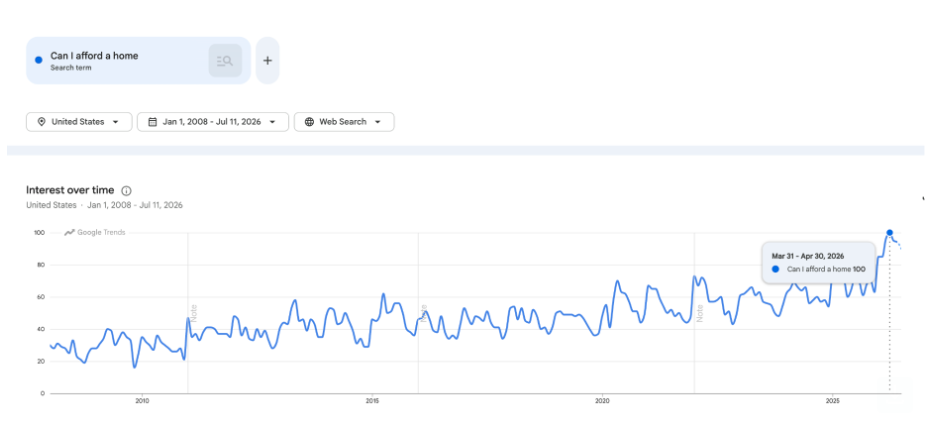
Apparently and unfortunately, the answer to this query for many is “nope.” Existing home sales are sitting near their lowest February level since 2009.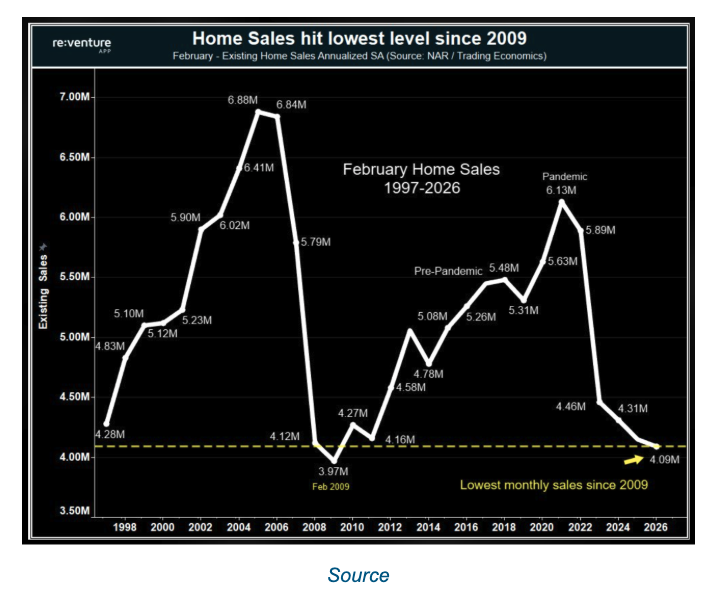
At the same time, home prices haven't collapsed. Typically when demand disappears, prices follow. That's not happening this time around.
Since 2022, the monthly cost to buy a house with a new mortgage has pulled dramatically away from both the cost to rent and the cost carried by existing owners on their current mortgages. As of late 2025, a new buyer's mortgage payment runs about $2,610 a month on average, versus roughly $1,985 for rent and $1,934 for mortgages paid by existing home owners.
Nick Gerli, CEO of real estate data platform Reventure App, calls this the "payment gap." It's the difference between renting and owning, and it doesn't just discourage buyers. It discourages sellers too, since anyone who already owns has little reason to trade in their mortgage for a more expensive one.
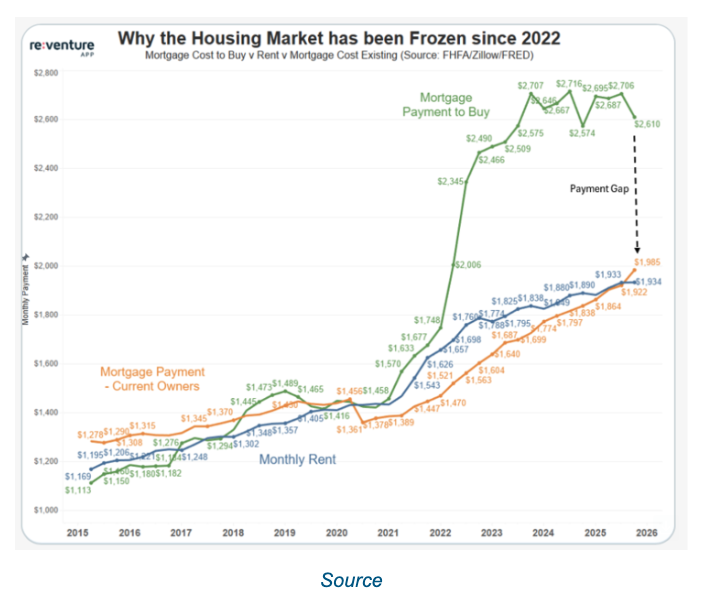
In other words, buyers can't justify the transition from renting to owning when it costs $600+ more per month for an equivalent home. Existing owners with low mortgage rates have little incentive to trade them in for today's higher rates.
The result is a market where almost nobody can afford to move.
How Bad Is It, Actually?
For most of the postwar era, the rule of thumb was a home cost about three times a household's annual income. Today, nationally, that ratio is closer to five- or six-times annual household income. Home prices rose roughly 47% between early 2020 and 2023 alone, while incomes climbed at nowhere near that pace.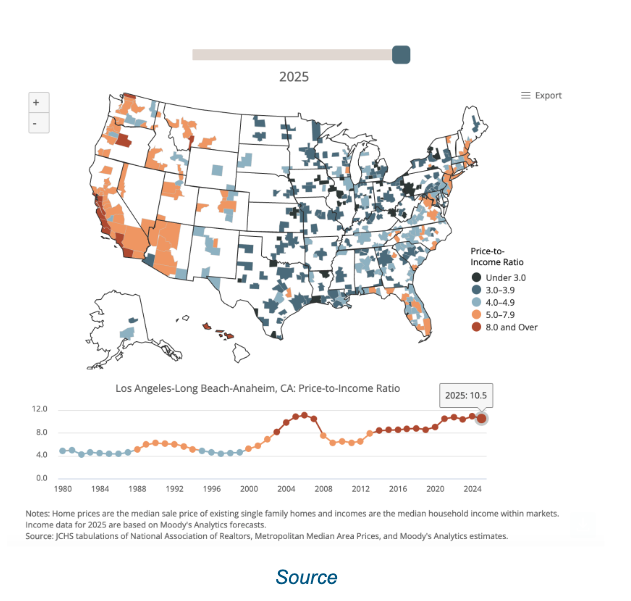
In dollar terms, the income needed to afford the typical home, assuming a 20% down payment and spending no more than 30% of monthly income on the payment, has more than doubled in a decade, from about $43,700 in early 2016 to a peak of $98,900 in mid-2025, before easing to around $93,000 by early 2026.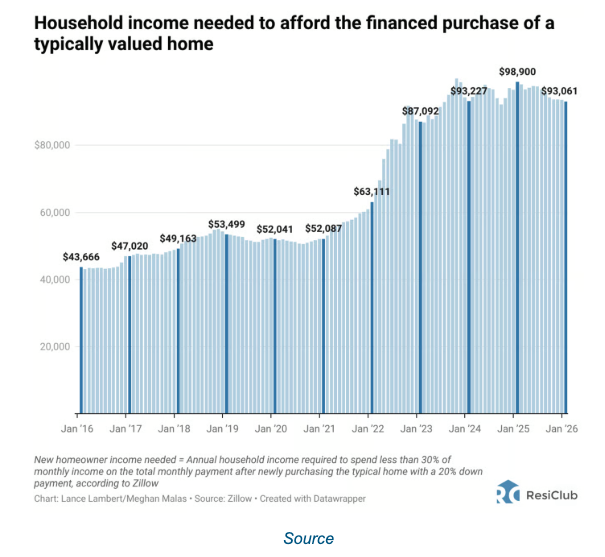
Looking at price alone understates the problem, as most people don't buy a house with cash. They make a monthly payment. A $400,000 home financed for 30 years at 7% has a monthly mortgage payment nearly 50% higher than the same home financed at 3% annual interest. Rates alone can cause major changes in the monthly cost of home ownership, with no change in home prices.
A family earning the national median income, roughly $106,800, now needs about 32% of that income just to cover the mortgage on a median-priced new home, before taxes, insurance, or maintenance. In 2002, about 56% of American families could afford a modestly priced home in their state. Today, an NAHB estimate puts that share at roughly one in four.
I sat down for a podcast discussion with Barry Habib, CEO of MBS Highway to get his perspective. His take: some of those folks Googling “can I afford a house?” might be able to after all, but there’s a lot of misconception. From Barry:
"The National Association of Realtors did a study and found... that 45% of first-time homebuyers were under the impression that they needed 20% down. Almost half. So they may not even be looking for a home, because they think it's out of reach." The real number, he says, is closer to 3.5% to 5% down.
Barry also pointed out that the share of first-time buyers closing on homes hit 33% and 35% over the past two months, up from a range that had been running 27-30%. Granted, he admits, it may reflect a February rate dip working through the pipeline and could fade now that rates are rising again. But for two months running, more first-time buyers closed on a home.
Why Existing Homes Aren't Coming to Market
Most outstanding mortgages, by some estimates 80% or more, are fixed at rates below 6%, with many below 4%. My last mortgage was at 2.875%. I hated to see it go. A homeowner with a mortgage around 3% will see their rate double if they move. For many, that’s enough to keep them from moving.
That may be changing. As of late 2025, the share of mortgages at 6%+ (21.2%) has overtaken the share below 3%, for the first time since before the pandemic. Roughly 5-6 million Americans take out a new mortgage every year regardless of the rate environment, and each year that happens, the pool of ultra-low-rate holders shrinks. As a result, the lock-in effect is fading.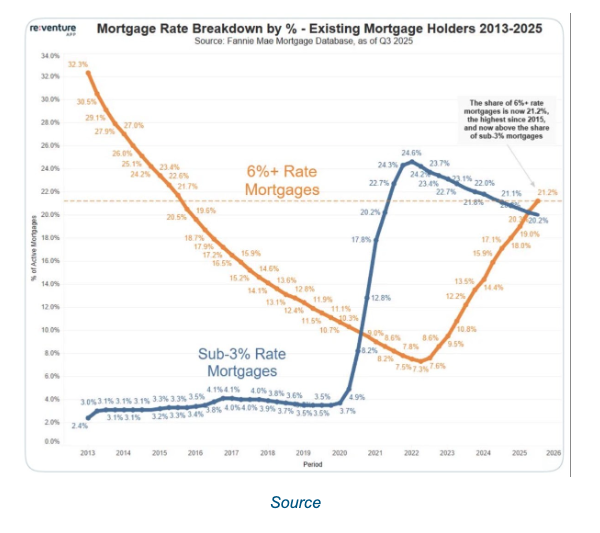
Just Make Smaller Houses
A few weeks ago an astute reader pointed out that the "starter home" of decades past was roughly 900-1,200 square feet. Today's newly constructed houses are much larger. He suggested buyer tastes are driving up the size, and therefore the cost, of starter homes. Based on our research, the reasons have more to do with home builder economics than buyer preferences.
Here’s Barry again:
"People say... that the consumer doesn't want [a smaller starter home]. Well, they might want it. They might be okay with it. But it isn't the consumer here, it's the actual developer or the builder: the margin on building that smaller home is not as attractive. So they're going to go where the margin is."
Land, permitting, and regulatory costs are largely fixed regardless of house size, so a small home's margin is thin to nonexistent while a bigger home spreads those costs over more square feet. NAHB estimates permitting-related requirements and fees alone add roughly $38,000, about 7.6%, to the cost of an average new home.
Builders are a part of the supply story. Existing sellers are the other, and they're starting to get motivated. Here's what seller motivation looks like across the country.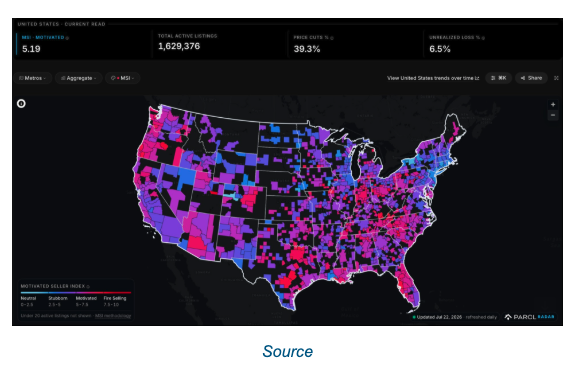
Nationally, about 39% of active listings have had at least one price cut, more across the Sun Belt. Parcl's Motivated Seller Index, which scores seller urgency on a 0-to-10 scale, currently sits at 5.19 nationally, squarely in what the index calls "motivated" territory rather than "stubborn" or "neutral." Sellers are adjusting to a market that no longer bids up every listing automatically.
Having moved in the past two years after “winning” a bidding war, I see this cool down as a good thing.
Where This Leaves Us
Every one of these statistics has the biggest impact on one group: first-time buyers. They are entering a market that looks nothing like the one their parents or grandparents faced at the same age. The country isn't short on land or the ability to build. It's short on homes affordable to build, and short on existing homes willing to change hands at an affordable price.
Those of us with gray hair know, the market doesn't move in one direction forever. I once suffered a paper draw down of 25% and had to wait almost 20 years for my home to regain its original value. I’m not predicting that type of adjustment today, at least, not nationally. What we are starting to see in most markets is fewer owners staying locked into their old mortgage rate instead of selling. Asking prices are being adjusted. And for the first time in a while, more first-time buyers are closing. These could be early signs the imbalance is correcting.
That still leaves the harder question. Homeownership in the US has been the primary path to building net worth. It was the main reward for showing up and working hard. It’s the thing Levitt believed made a man too busy building a life to tear one down.
If an entire generation feels that path is no long available to them, the ramification could be severe. Since the end of WWII, housing has been akin to a “right” in that a house was achievable for anyone who worked for it. If today’s younger generations are being asked to work like we worked, but are denied the opportunity to build wealth and security through home ownership, what will their answer be?
Some people are already answering that question. One example comes from The Rational Optimist Society, which recently highlighted a company called Cuby Technologies, a company rebuilding the factory process behind ordinary, site-built houses. Using their "mobile micro-factories," they say they can build homes in roughly 45 to 60 days from foundation to finish, with a stated goal of getting that under 30 days. Their one documented US build, in Michigan, came in 30% to 40% below local contractor quotes. It's still very early, but if the model holds up at scale, it's the kind of disruption that could put home ownership within reach for more families.
Regardless, my feeling is we need to build more houses in the US, at a lower cost. Lowering permitting costs and obstacles is part of it. So is the same kind of disruption that built Levittown in the first place, standardized, modular construction, mass production, whatever the modern equivalent turns out to be. It worked once. There's no reason it can't work again.
Let me know what you think — reply to this note or drop a comment.
Thanks for reading.
Ed D’Agostino, Partner & COO
A message from Advisor Perspectives and VettaFi: Discover something new! Click here to register for our upcoming webcast
Membership required
Membership is now required to use this feature. To learn more:
View Membership Benefits