Long Term Rate Headache
Membership required
Membership is now required to use this feature. To learn more:
View Membership Benefits
Superbubble Popping?
Condominium Prices Fall
Shifting Center
“A Considerable Lag”
Philadelphia and Washington, DC
I talk about the Federal Reserve often in these letters, and for good reasons. Fed policy has enormous influence on the economy. Yet the Fed has far more power in some areas than others. It has deep, almost dictatorial control over short-term interest rates and overnight bank liquidity and much less power over long-term yields. Yes, the Fed has some power over mortgages and Treasury bonds, but it’s not as simple as taking a vote. The actual mechanism for the Fed to influence mortgage and long-term rates is very complicated and often counterintuitive.
This matters because long-term credit is how we finance the long-term growth everyone wants to see. It’s also how Americans finance their homes, which for many is their single most valuable asset. Often, unlocking home equity is a key part of the retirement plan… which is problematic when that equity amount proves smaller than expected.
Today we’ll consider the interaction between long-term interest rates, the Fed’s limited ability to influence them, inflation and the housing market. And because home prices are the biggest concern for many households, we’ll start with a look at the latest changes there. And then look at the Federal Reserve’s likely reaction.
Superbubble Popping?
Is housing price inflation good or bad? The answer depends on whether you are a buyer or seller. Price appreciation helps current homeowners while raising costs for buyers. Conversely, lower home prices work to the benefit of buyers and the detriment of sellers. That may seem like an obvious distinction, but it’s easy to forget. Try to keep it clear in your head.
Remember, too, that home prices depend on other prices: construction materials, skilled labor, fuel, insurance, taxes, and more. And of course, interest rates, i.e., the price of money.
Inflation in all those categories drove home prices higher in the last few years. The good news (for buyers, at least) is that prices are stabilizing or even falling in many areas. Wolf Richter has a great roundup of the price action in 33 key markets.
“Prices of mid-tier homes in June were down from their respective peaks in prior years in 28 of the 33 big and expensive cities we follow here, led by Austin (-27%), Oakland (-25%), New Orleans (-19%), Washington D.C. (-13%), Denver (-13%), Phoenix (-11%), Fort Worth (-10%), and Portland (-10%). All of the prices are seasonally adjusted.”
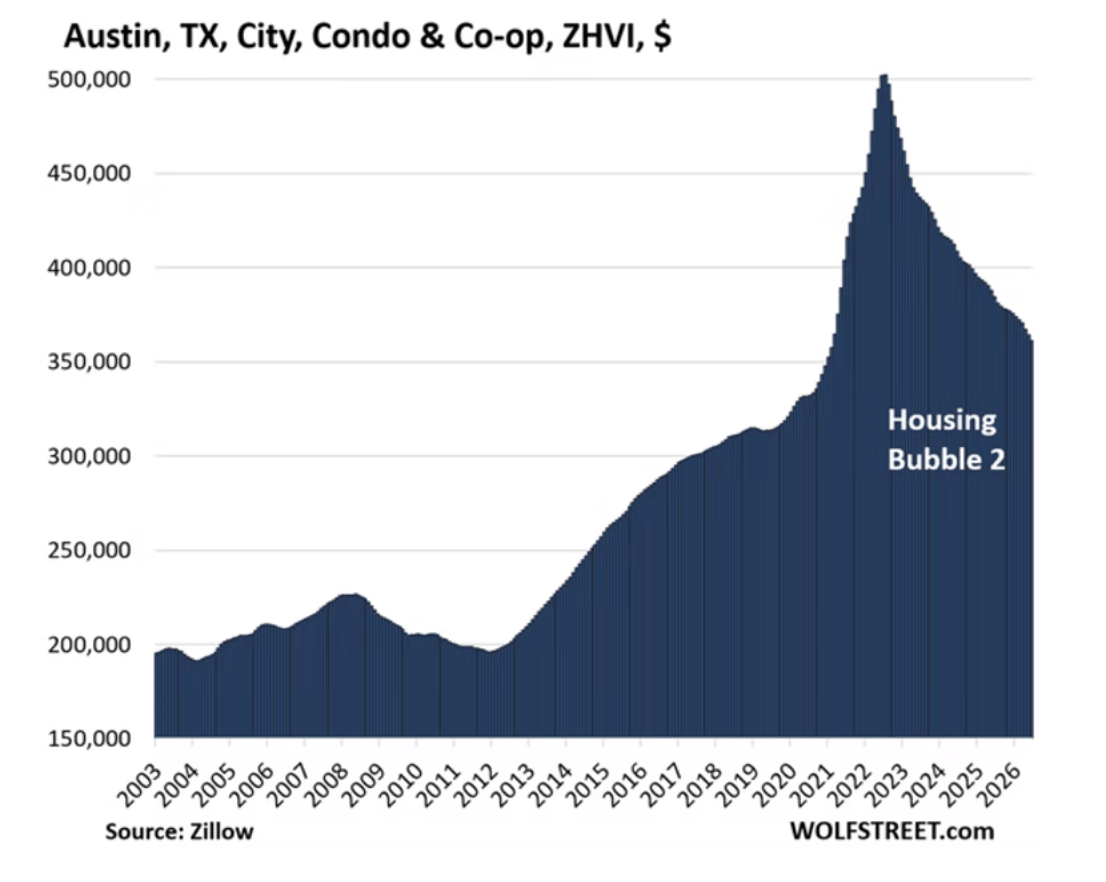
Here’s a look at Austin, where home prices rose almost vertically in the COVID era and are now down by 27% over the last 4 years!
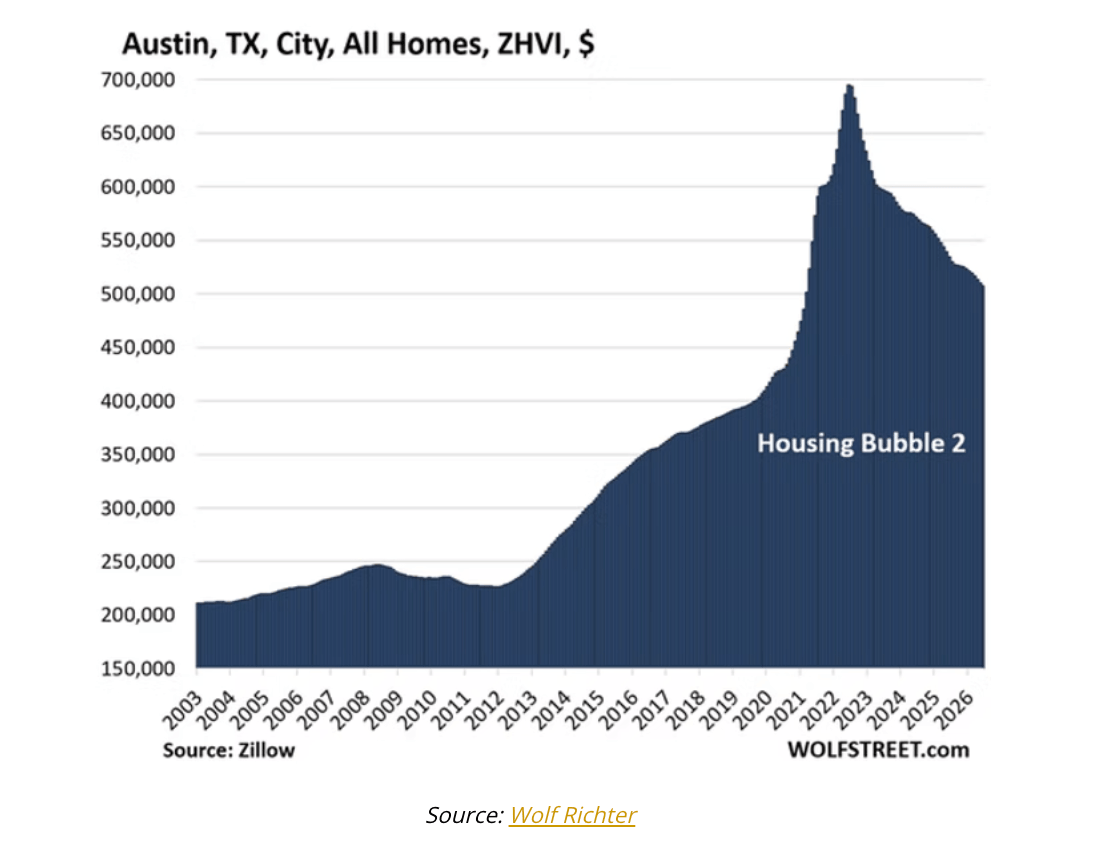
Wolf calls the post-2020 period “Housing Bubble 2.” That’s accurate but, in the Austin case, may not be strong enough. Housing Bubble 1 (roughly 2005-2008) looks like a small bump in comparison. I don’t know what to call the more recent example. A Superbubble, perhaps?
The difference is less dramatic but still stark in places like Phoenix, down 11%. While you can click on Wolf’s link above to see all the cities, Phoenix is more typical. There was a big post-Covid surge and current prices have corrected some but not dramatically. My personal opinion is that much of US housing has some more correction to undergo.
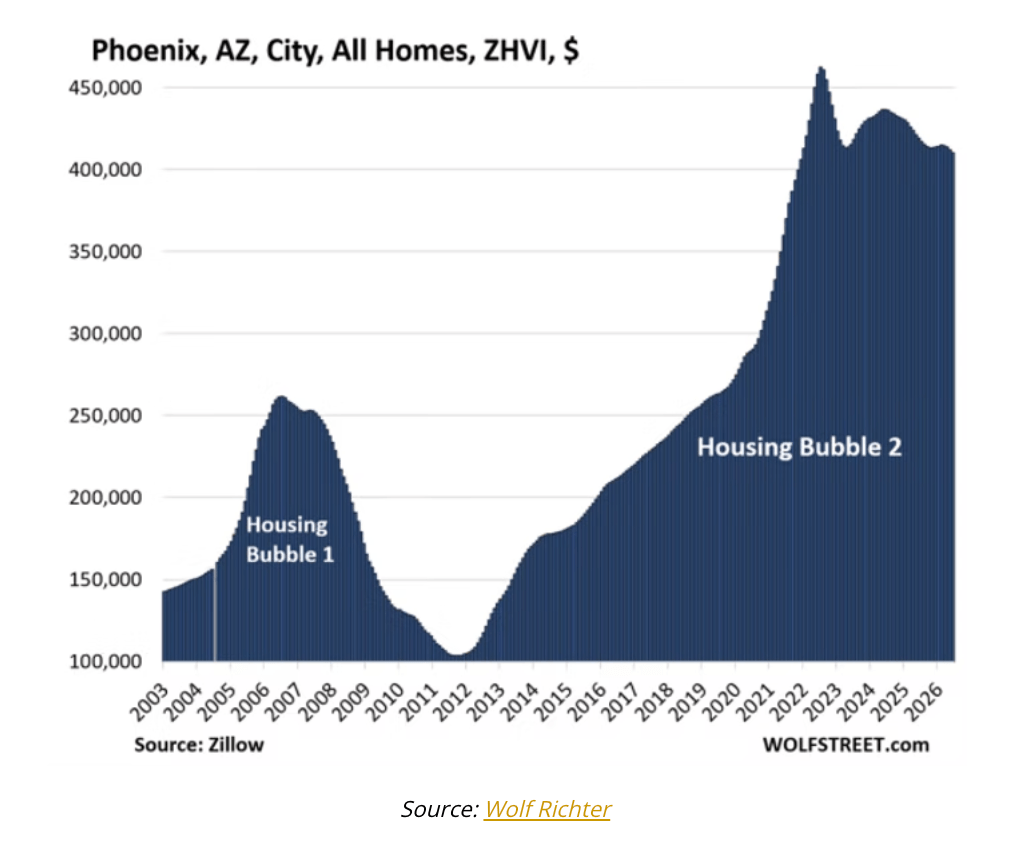
ZHVI stands for Zillow Home Value Index. It includes single-family homes, condos and co-ops and draws on transaction data from public records. Some 25 of the 33 cities the report covers saw year-over-year price declines as of June 2026. Eight cities saw price increases, including New York, Chicago and San Francisco.
Which underscores the old line that “All real estate prices are local.” The dynamics of New York is obviously different than Austin or Dallas.
Condominiums Prices Fall
Homeownership in America is constantly on the move. In fact, some 65.8% of Americans own a home as of 2025. About 27% of people in the U.S. live in a condo or HOA property. And the condo market is under stress. Condo prices, in general, are down more than single-family homes, although obviously different in some markets. Again from Wolf Street.
“Condo prices fell by 15% to 33% in 30 bigger cities, and in some cities prices have fallen back to 2006 levels. In another 39 bigger cities, condo prices fell by 8% to 14%. A massive hangover after a historic Condo Bubble.”
A few examples:
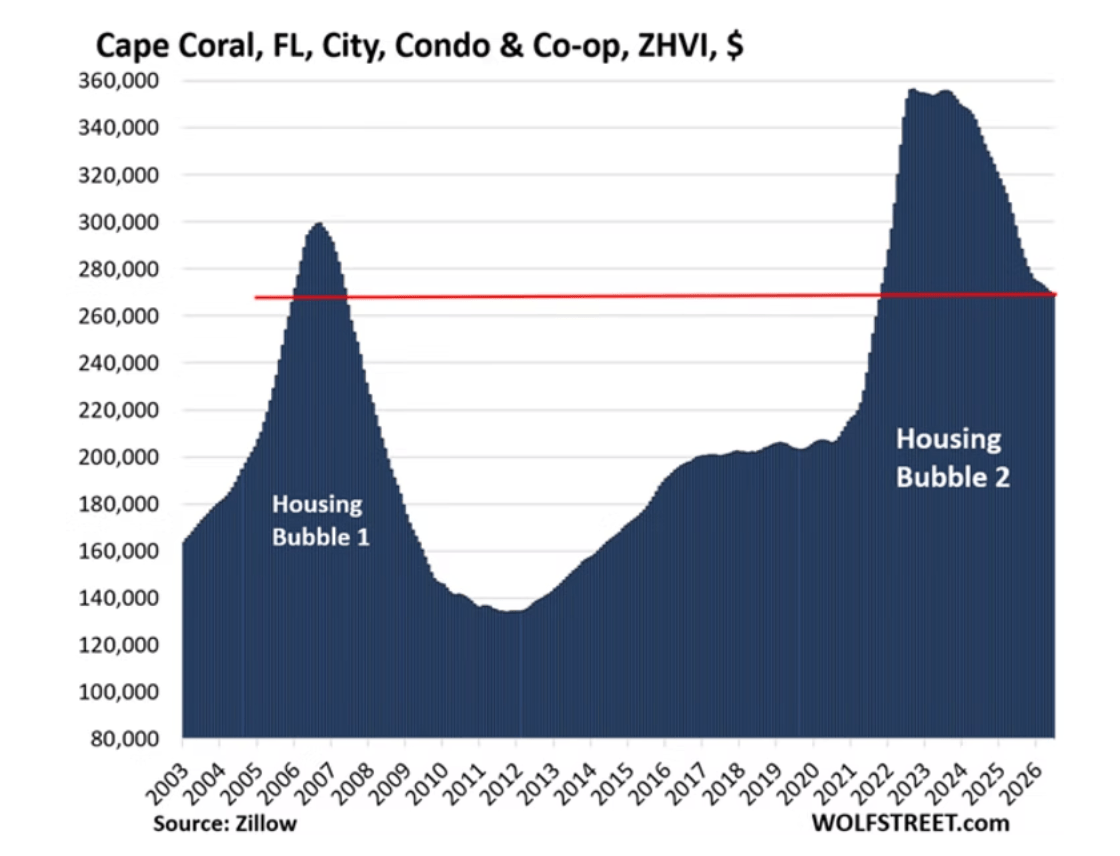
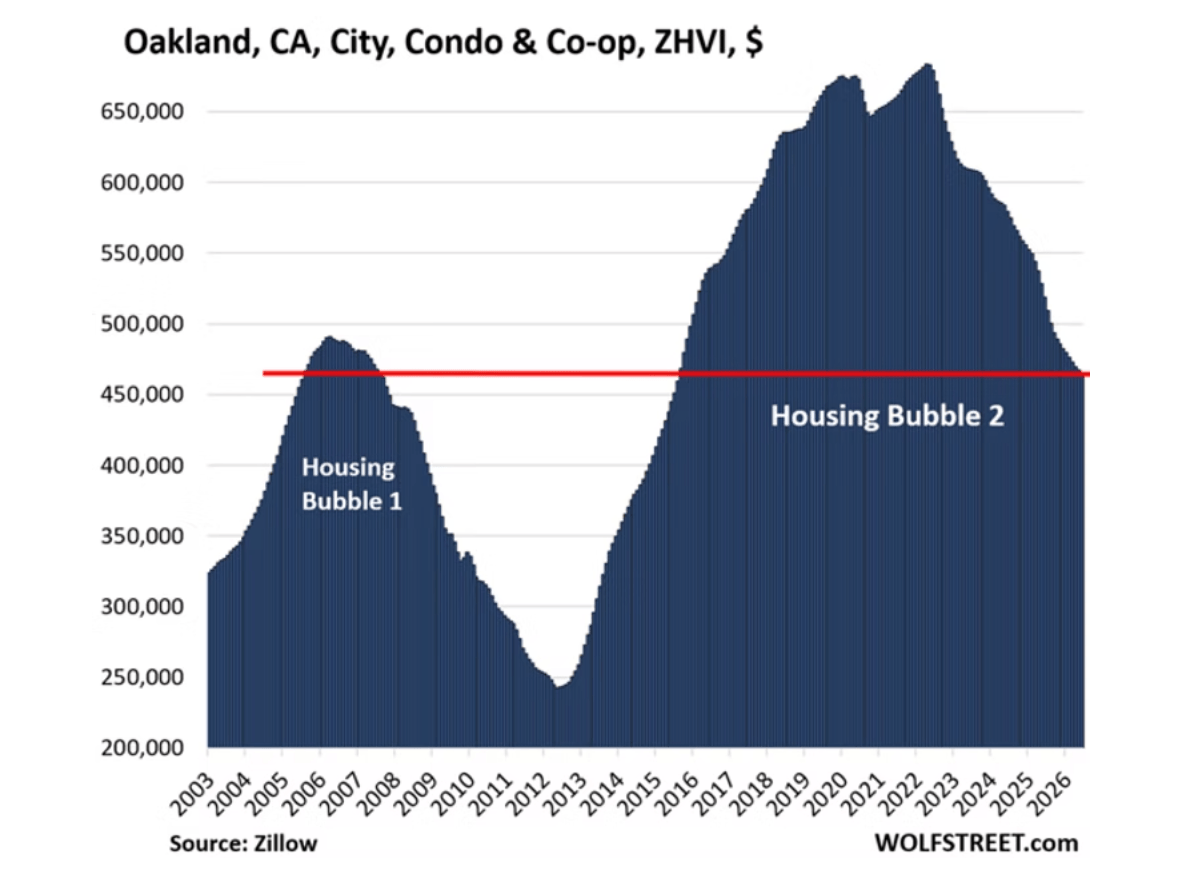
A lot of cities did not see a large price increase during the first housing bubble. The price shock happened afterward but prices are still dropping. Consider Austin, where condos are down 28%:
Shifting Center
Generally speaking, home prices are off their peaks in most of the country but remain considerably higher than they were before the COVID-era Fed decided to save the economy by driving mortgage rates down.
I mentioned above the Fed has limited control over long-term rates. How did this happen, then? The answer is quantitative easing or QE. The Fed buys vast quantities of bonds – mortgage-backed securities, in this case – which raises their price and reduces their yield. That lower yield flows through to mortgage borrowers.
Look how the Fed’s MBS portfolio ballooned starting in 2020.
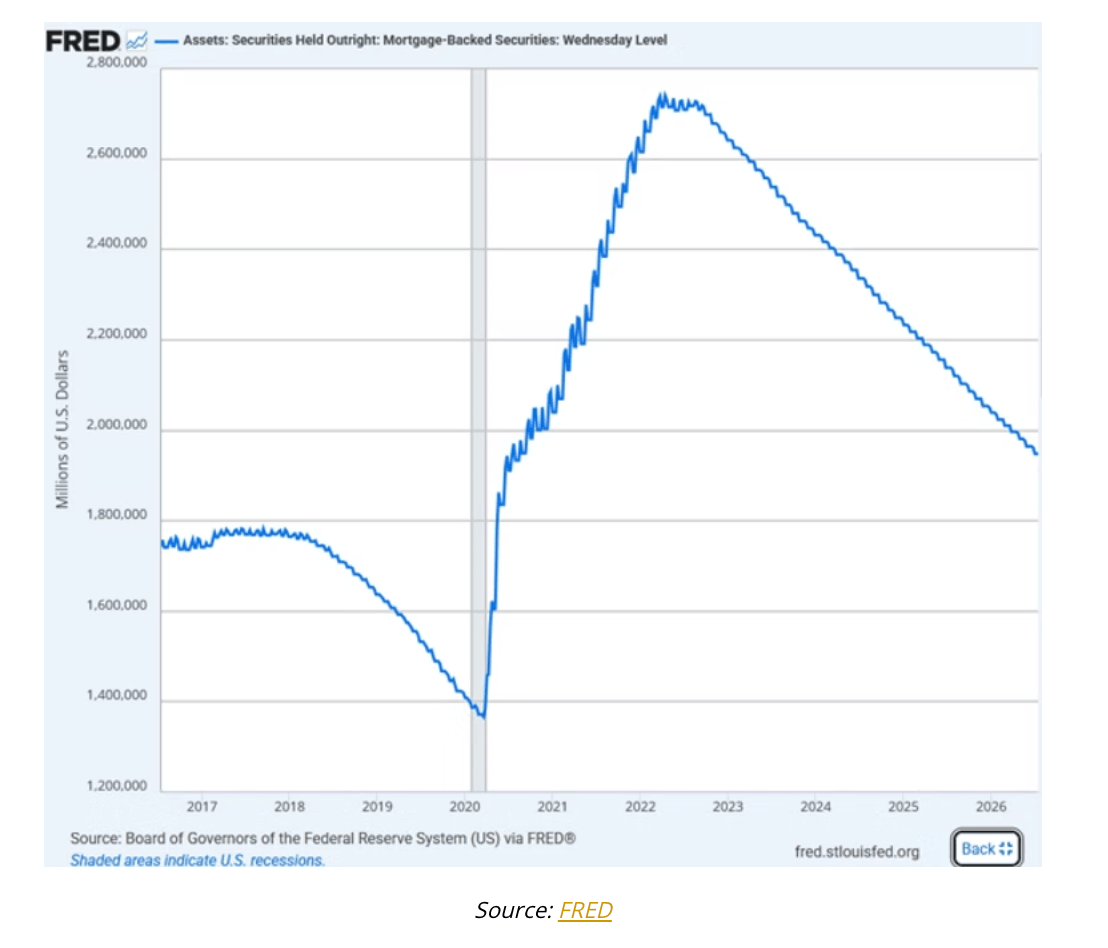
This roughly $1.4 trillion infusion had the desired effect, even more dramatically than the original QE rounds that began in 2009. The former amount was similar but happened over about six years instead of two.
Given the opportunity to lock in 30-year mortgage loans at rates as low as 2%, creditworthy Americans jumped at the chance. Home prices leaped accordingly in 2020-2021, then moved higher again in 2022 and following as the Ukraine war’s effects raised rates out of the basement and also made new construction more expensive.
I talk often about the unintended and often unpredictable side effects of policy changes. This one gave us the “lock-in” effect. Homeowners with ultra-low mortgages became reluctant to sell because buying another home would mean a much higher loan rate. This reduced the supply of homes for sale. And, as we all know, reduced supply in the face of rising or flat demand means higher prices.
Fortunately, the lock-in effect isn’t permanent. People with low-rate mortgages may not be eager to sell, but sometimes life happens. They die, get divorced, move to nursing homes, get better jobs, and so on. So, the percentage of mortgages in this category has been slowly falling over the past four years, which helps prices fall.
This chart shows the share of mortgages by rate. You can see how the lowest two groups (<3% and 3-4%) zoomed higher in 2020-2021. Now both are falling, albeit slowly, while the top (>=6%) category is gaining share.
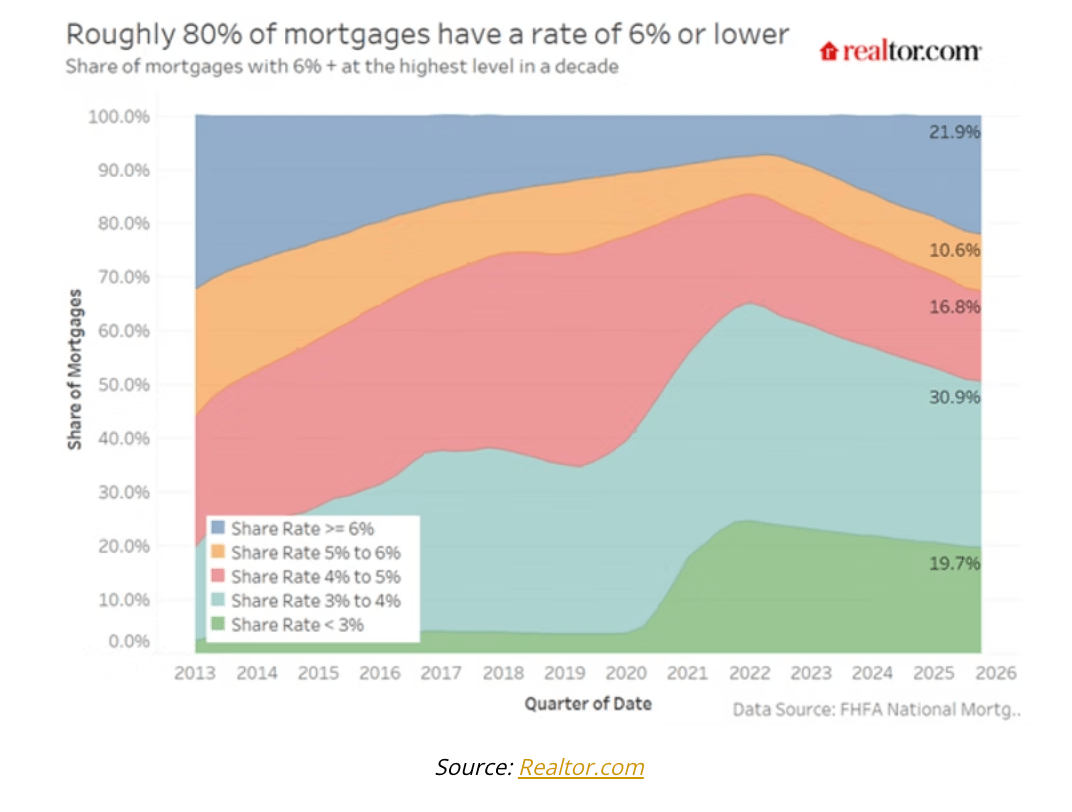
Here is the Realtor.com outlook…
“Altogether, just over half of outstanding mortgages (50.6%) still carry rates of 4% or lower, and roughly 78% have a rate below 6%. The 6%-or-higher share now stands at 21.9%, up 3.9 percentage points from Q4 2024’s 18.0%, a meaningful year-over-year acceleration driven by sustained buyer activity despite elevated borrowing costs.
“The share of homeowners holding a mortgage with a rate of 6% or higher increased nearly 4 percentage points between Q4 2024 and Q4 2025, as buyer activity carried on despite high rates. Even in today’s high-price, high-rate market, homebuying activity around major life events, such as having kids, a job change, or a divorce, keeps the market in motion. Easing inflation and mortgage rates will be key drivers of seller activity as well, which will relieve some of the price pressure and competition in today’s undersupplied market…
“While roughly 78% of outstanding mortgages still carry rates below 6%, indicating that the rate lock-in remains substantial, the steady quarterly erosion of the sub-4% cohort and the accelerating growth of the 6%-plus population suggest the market’s center of gravity is gradually shifting. The question for 2026, now complicated by renewed rate volatility tied to geopolitical uncertainty, is whether relief arrives fast enough to unlock reluctant sellers before another spring season slips by.”
This is a great example of the market’s invisible hand fixing the Fed’s folly, but at significant cost. It takes time but eventually works.
“A Considerable Lag”
When people call for the Fed to fix housing inflation, I often smile because the Fed is a prime cause of housing inflation (and inflation generally). It may have been with the best of intentions, but that’s just reality. Relying on the arsonist to put out the fire is rarely effective.
I think the new Fed under Kevin Warsh is unlikely to launch any new QE-type programs or otherwise try to influence long-term rates, other than reducing the Federal Reserve’s active balance sheet. He seems happy to let the market go where it wants. This year, that’s often meant higher.
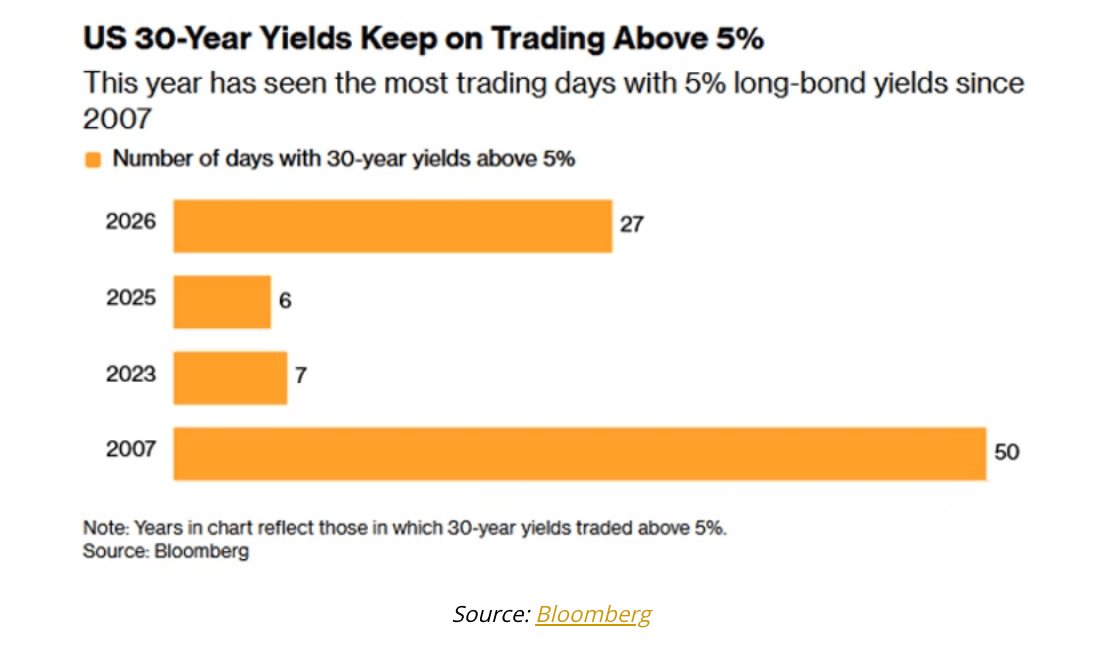
This is a continuation of the trend since 2022. The 30-year Treasury yield is almost back where it was in 2007.
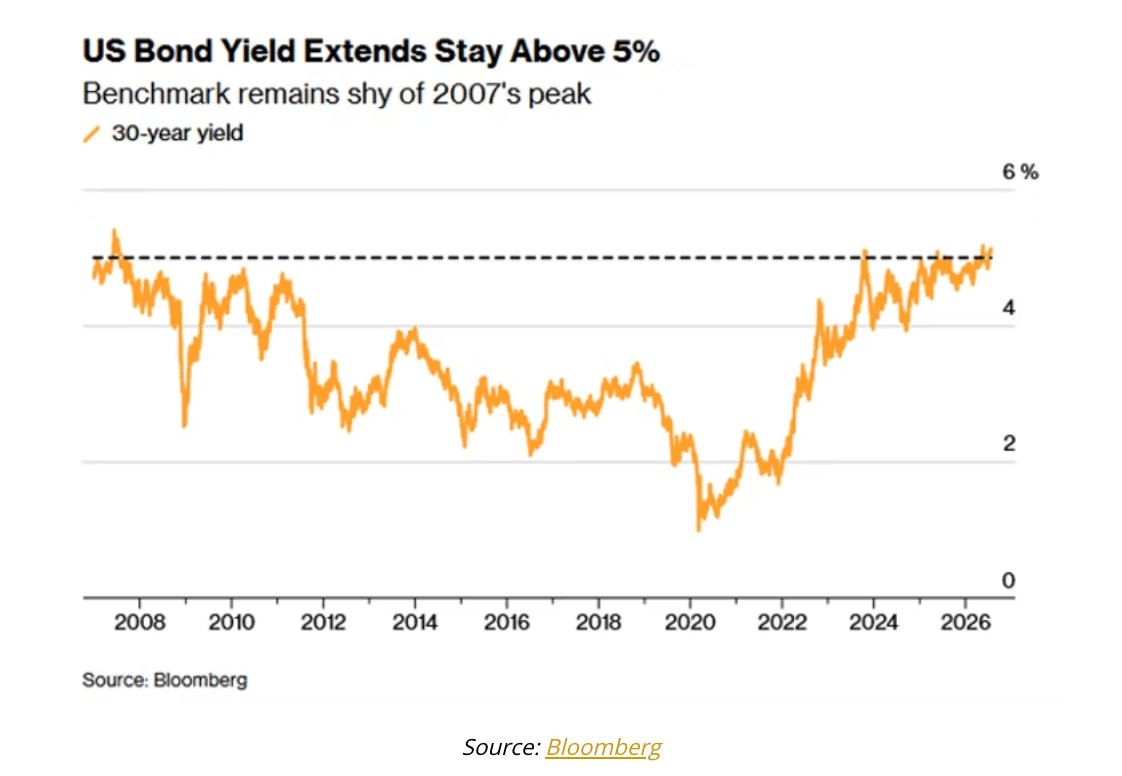
Lacy Hunt made waves this year by reversing his longtime lower-rate stance. As he explained in his quarterly report this month, the structures that produced global disinflation from 1990-2020 have eroded. He primarily means globalization which has lowered prices in a long-term disinflationary trend accompanied by the supply shock from both Russia (primarily energy) and China and Asia (damn near everything else). This era is over. He now expects persistently higher inflation levels and interest rates, which the Fed is aggravating by injecting yet more liquidity this year. (More below.)
My expectation is that at next week’s FOMC meeting they will at a minimum stop increasing the balance sheet but more likely they will also begin to reduce it. In a private group conversation with Lacy, he believes that reducing the balance sheet will have more impact than simply raising rates, though both may happen.
Lacy believes the recent increase in the balance sheet was the primary driver of increased inflation this last year. Powell did not cut rates as Trump wanted, but he did dramatically increase the balance sheet.
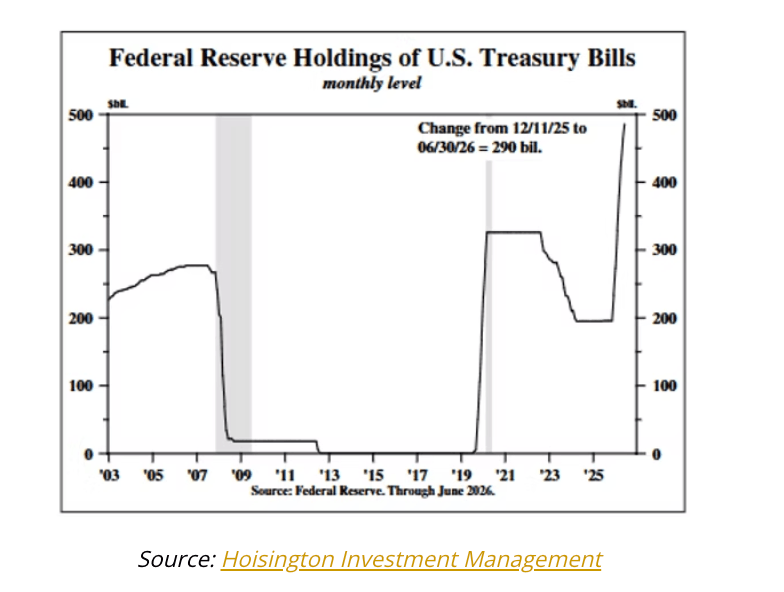
Lacy thinks the $290 billion in Fed T-bill purchases since last December may explain how inflation started accelerating in February, even before the Iran war produced an energy shock. Typically, when banks have more money because the Fed is buying bonds, that cash shows up as excess reserves. This time, banks dramatically increased their lending across many sectors, which spurred the inflation. The classic too much money chasing too few goods…
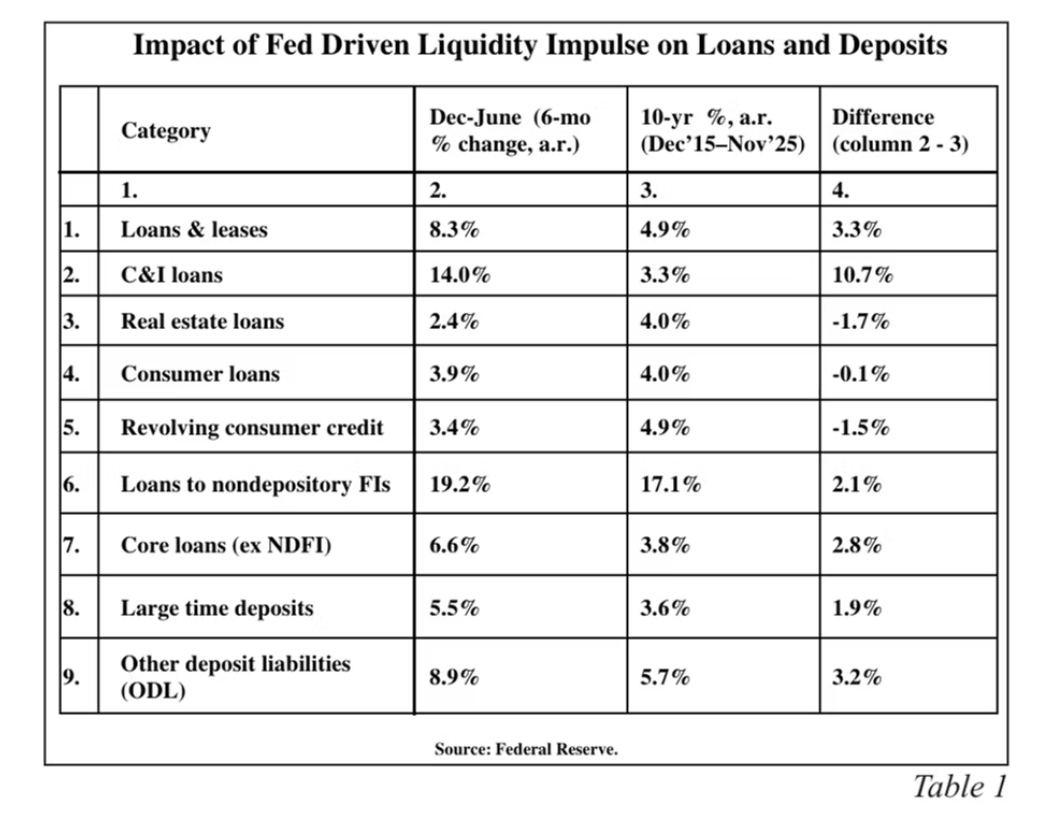
This leaves the Fed in a pickle, according to Lacy.
“Chairman Warsh inherits an immediate situation where money growth needs to materially slow if Fed policy is to avoid reinforcing inflationary momentum. The challenge is that the short-run financial effects of balance sheet reduction may differ substantially from the longer-run inflation effects. Markets that have become accustomed to abundant liquidity may initially experience tighter financial conditions, while the eventual disinflationary benefits of monetary restraint may emerge only with a considerable lag.”
Sidebar: Raising short-term rates, as may happen next week, isn’t likely to change this big-picture problem. Any serious attempt to fight inflation will run head-on into markets that greatly enjoy the status quo. Can Warsh manage the temper tantrum long enough to actually accomplish what he wants? I hope so.
By the way, I should note good friend Dave Rosenberg disagrees with Lacy Hunt’s latest call. Dave thinks a hawkish Fed may actually spark the recession he’s long expected. Here’s a small snippet of his response to Lacy.
“Tightening into a sub-2% growth environment with nominal wage growth easing and stable inflation expectations would be both a weird and irresponsible move. But the Fed has talked the markets into pricing in not just one but two moves in the next year. What the Fed has really caused here is a major communications problem before there has been any reason for a shift in the actual policy stance.
“The situation has been compounded by the framework change. Removing forward guidance and reinforcing price stability twelve times in one press conference transfers uncertainty into the term premium rather than into the policy rate. You're seeing the cost in a steeper and higher yield curve — the long end is absorbing volatility that the Fed used to absorb through guidance. But the real risk runs the other way at this point, for if the labor data continue to deteriorate on the June trajectory, and a Fed that has spent the summer talking about price stability thinks it must deliver or risk its credibility — well, this is the policy error that produces the recession nobody expects.”
I should note that Lacy acknowledges the possibility of a recession in both his writing and in his conversations. He writes in his recent piece that "absent a sustained recession, a favorable supply-side shock, or a prolonged period of monetary restraint, the broader structural backdrop ... suggests inflation and Treasury yields will trend upward." He clearly doesn’t believe that reducing forward guidance increases volatility in the long end.
Lacy’s latest case has actually caused quite a stir in many corners of the economic world. You should read it, at least once or twice. I’m going to close with some analysis on inflation and Lacy’s essay from David Bahnsen’s latest Dividend Cafe. I should note that I am in wholehearted agreement here. Quoting David:
“Dr. Hunt has been a long-time proponent of the view (which I share) that the long-term inflation range has been compressed by the twin effects of fiscal and monetary policy interventions. I refer to this dynamic as "Japanification" and argue both from history and economic theory that excessive government indebtedness, followed by the elixir they use to treat it all (fiscal and monetary interventions), puts downward pressure on economic growth, and in that sense is either disinflationary (best case) or deflationary (Japan's generational experience). Regardless of the outcome to the price level, the impact on both nominal and real growth is erosive, and undermines the economic potential of a country (such as ours).
“Lacy has recently argued that the structural range of U.S. inflation is likely to move higher after 30+ years of this lower equilibrium range due to a "steady erosion of the disinflationary architecture that dominated the 1990-2020 period." He frames his argument for a new inflation range around the death of globalization.
“Essentially, the argument is that:
(a) Globalization accounted for the prior period's disinflation
(b) Globalization is dying
© Therefore, the prior period's disinflation will be gone
“The first premise - that globalization ushered in much of the disinflation of my adult lifetime - is connected to the fall of the Soviet Empire and the advent of China on the world stage. He rightly notes that this generated "one of the largest positive supply shocks in modern economic history." The positive dynamics out of this were "falling capital costs, low-cost energy, and rapid technological diffusion [which] reinforced productivity growth and expanded productive capacity." I believe both Lacy and I would refer to this as non-inflationary growth, and I wholeheartedly agree that it explains much of the 1990-2006 world we lived in. The aggregate supply curve did, indeed, shift outward and this dynamic served to absorb excess liquidity all the while facilitating disinflation in the price of goods.
“This globalization dynamic did not happen in isolation, though. Coincident with such global economic forces playing out, economic superpowers vastly increased debt at the same time. As Lacy has persuasively demonstrated, this "diverts income away from consumption and restrains aggregate demand growth." This is not said as a positive thing! It is all at once distortive and contractionary. It is at the heart of what I have considered Dr. Hunt's economic contribution to be over the last couple decades - the cogent analysis of how excessive debt impacts prices, liquidity, and growth.”
No one outside of the few members of the FOMC really has an idea what will happen at the FOMC meeting next week. I personally expect the Fed to start reducing the balance sheet, and I would not be surprised if they raised rates.
Warsh is in an extraordinarily difficult position. He needs to credibly demonstrate both his and the Fed’s independence and his stated determination to control inflation. A 25 basis point rate hike would accomplish both. In one sense, by acting now he demonstrates his credibility and that means that he will likely have to do less in 2027. The bond markets will likely jerk around for a little bit, but once market participants absorb that Warsh is very intent upon lowering inflation, I believe long-term rates will come down. Eventually, inflation will drop below 2%, and mortgage rates will drop correspondingly.
No matter what Chairman Warsh does, he will have a large amount of criticism. I think he needs to do what he believes needs to be done, but the rest of us have to deal with it. Then again, I have always been and remain an inflation hawk.
Philadelphia and Washington, DC
I have to go to Philadelphia for a quick business meeting the first week of August. My next planned trip after that will be to Washington, DC the week after the midterm elections for an Inner Circle meeting. It will be an interesting time for sure.
Looking at my clock, the deadline for this letter is now so it is time to hit the send button without further comment. You have a great week. And don’t forget to follow me on X.
Your thinking about the production functions analyst,
John Mauldin
A message from Advisor Perspectives and VettaFi: Discover something new! Click here to register for our upcoming webcasts.
Membership required
Membership is now required to use this feature. To learn more:
View Membership BenefitsSponsored Content
Upcoming Virtual Events View All