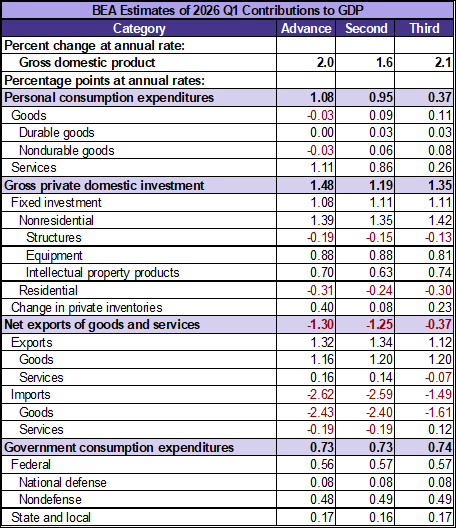
Real gross domestic product (GDP) is comprised of four major subcomponents: personal consumption expenditures, gross private domestic investment, net exports, and government consumption expenditures. In the latest Q1 2026 second estimate it was reported that real GDP increased at an annual rate of 1.6% with three of the four components making positive contributions.
Real gross domestic product (GDP) increased at an annual rate of 1.6 percent in the first quarter of 2026 (January, February, and March), according to the second estimate released today by the U.S. Bureau of Economic Analysis. In the fourth quarter of 2025, real GDP increased 0.5 percent. The contributors to the increase in real GDP in the first quarter were exports, investment, consumer spending, and government spending. Imports, which are a subtraction in the calculation of GDP, increased. (Link)
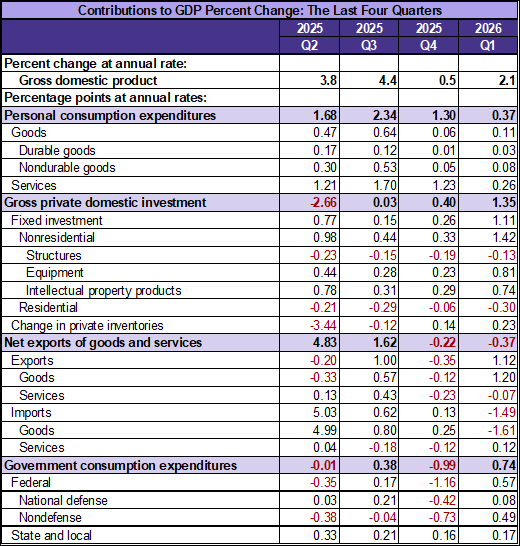
- Personal consumption expenditures (PCE) contributed 0.95
- Down from Q1 advance estimate
- Down from Q4 final estimate
- Gross private domestic investment (GPDI) contributed 1.19
- Down from Q1 advance estimate
- Up from Q4 final estimate
- Net exports of goods and services (NEGS) contributed -1.25
- Up from Q1 advance estimate
- Down from Q4 final estimate
- Government consumption expenditures (GCE) contributed 0.73
- Unchanged from Q1 advance estimate
- Up from Q4 final estimate
Over time, the personal consumption expenditures (PCE) component has demonstrated the strongest and most consistent correlation with real GDP. When PCE is positive, GDP tends to be positive as well, and when PCE declines, GDP often follows. However, there have been exceptions, such as in Q2 2022 and more recently, Q1 2025.
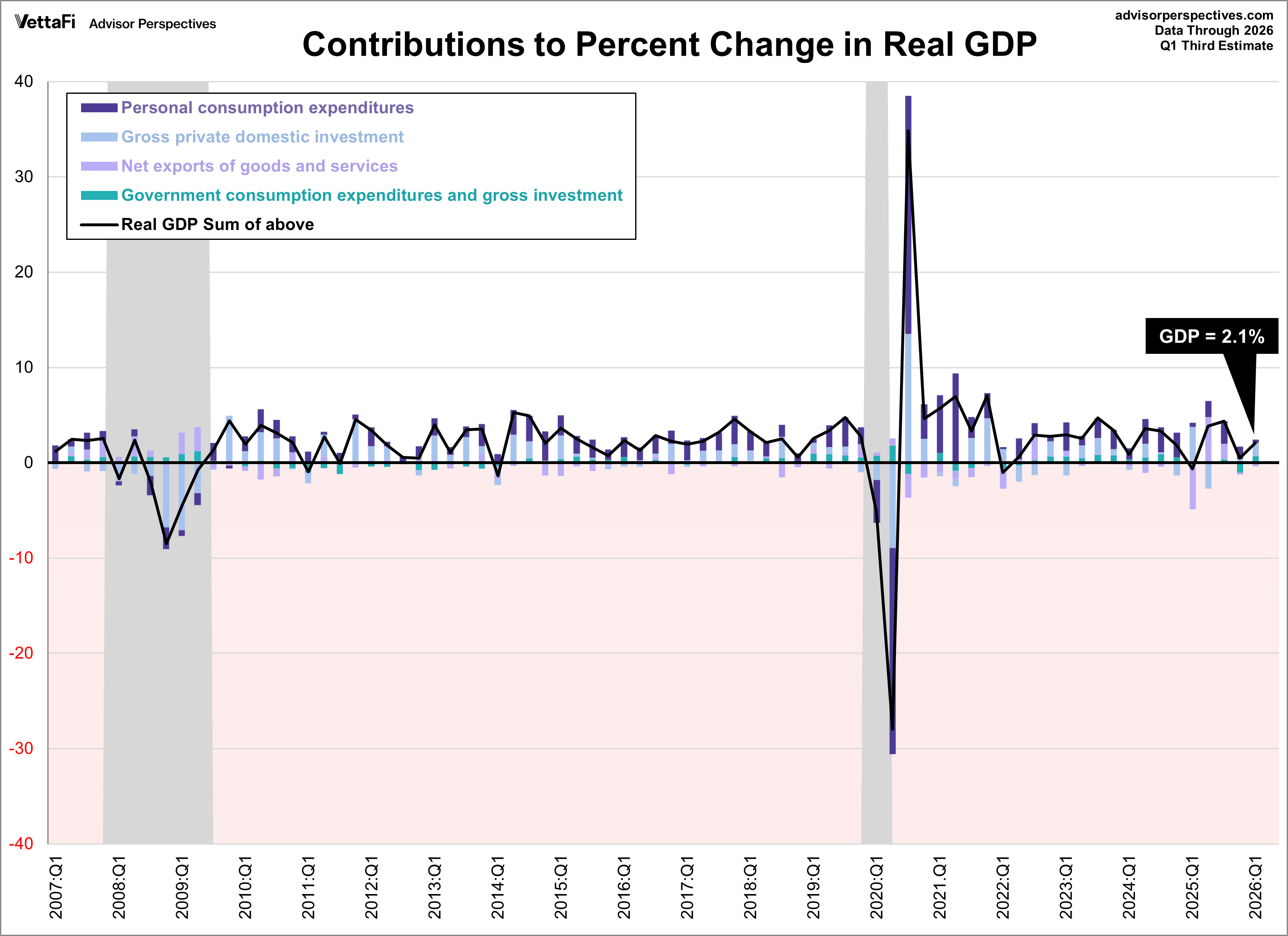
Visualizing Gross Domestic Product
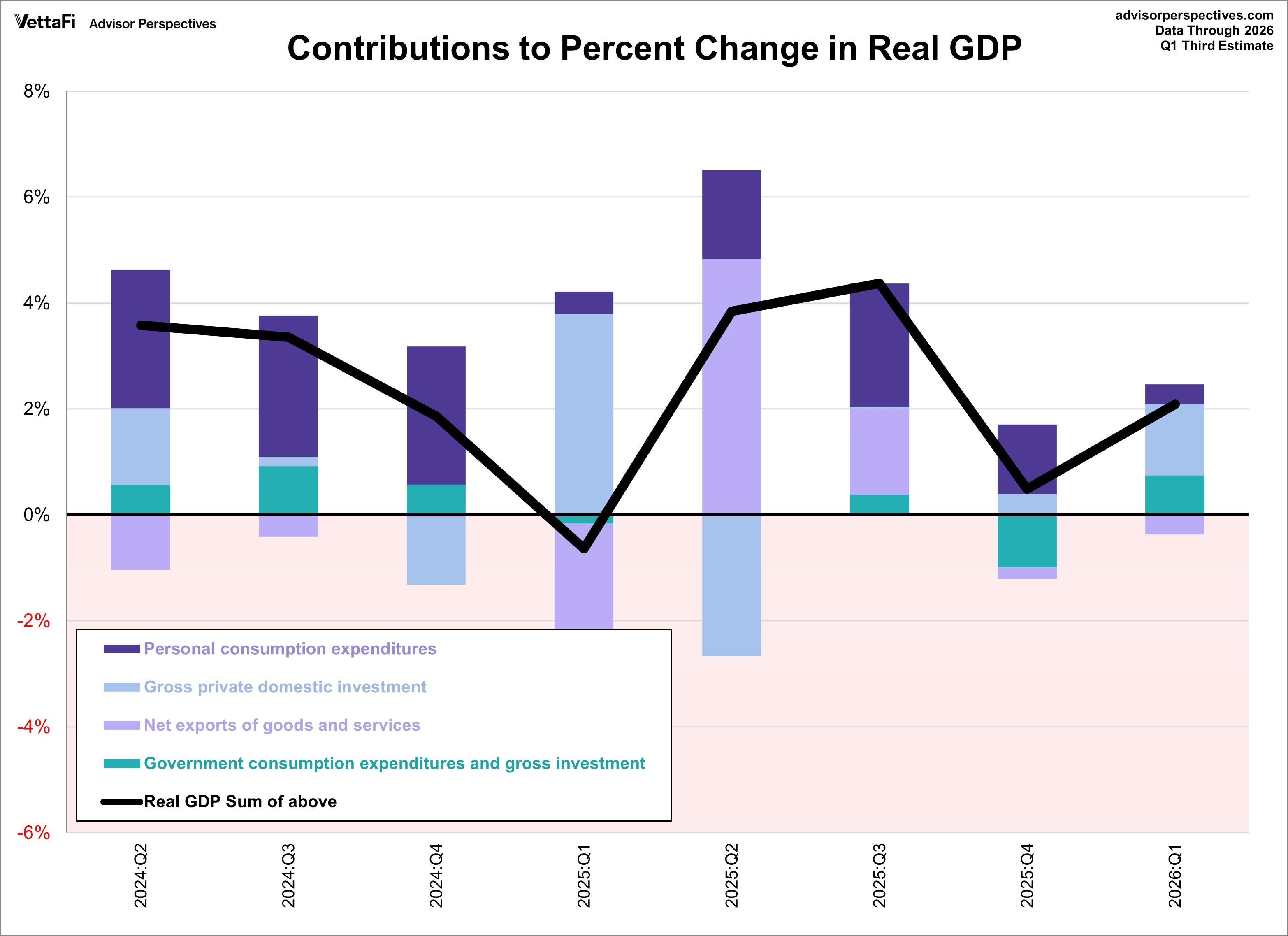
The accompanying chart is a way to visualize real gross domestic product (GDP) change since 2007. The chart uses stacked columns to segment the four major components of GDP with a solid line overlay to show the sum of the four, which is real GDP itself. The data source for this chart is the Excel file accompanying the BEA's latest GDP news release (see the links in the right column). Specifically, it uses Table 2: Contributions to Percent Change in Real Gross Domestic Product.

Here is the same chart but only showing the latest two years to get a clearer picture of each components' most recent contributions.

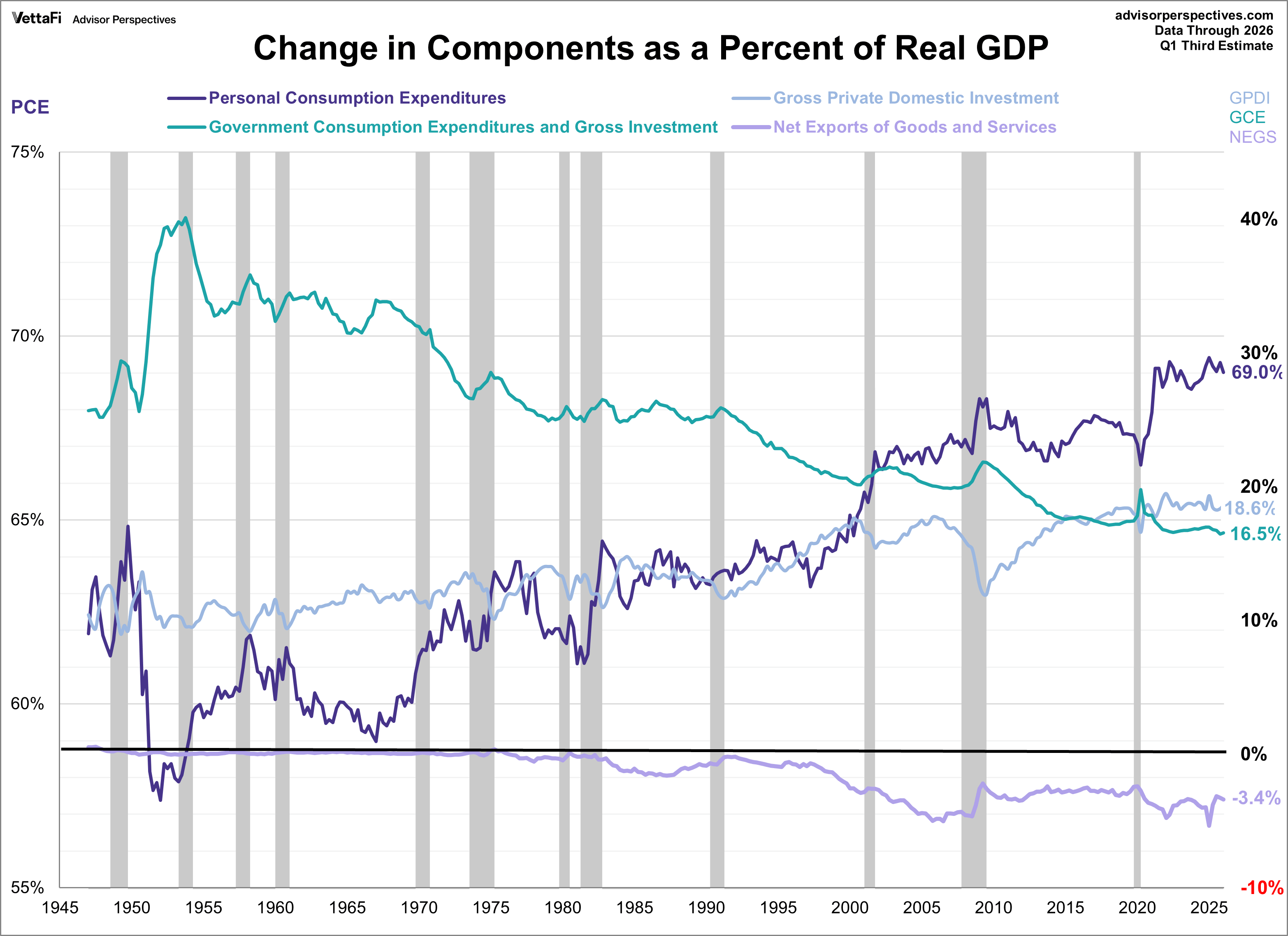
Components as a Percent of Real GDP
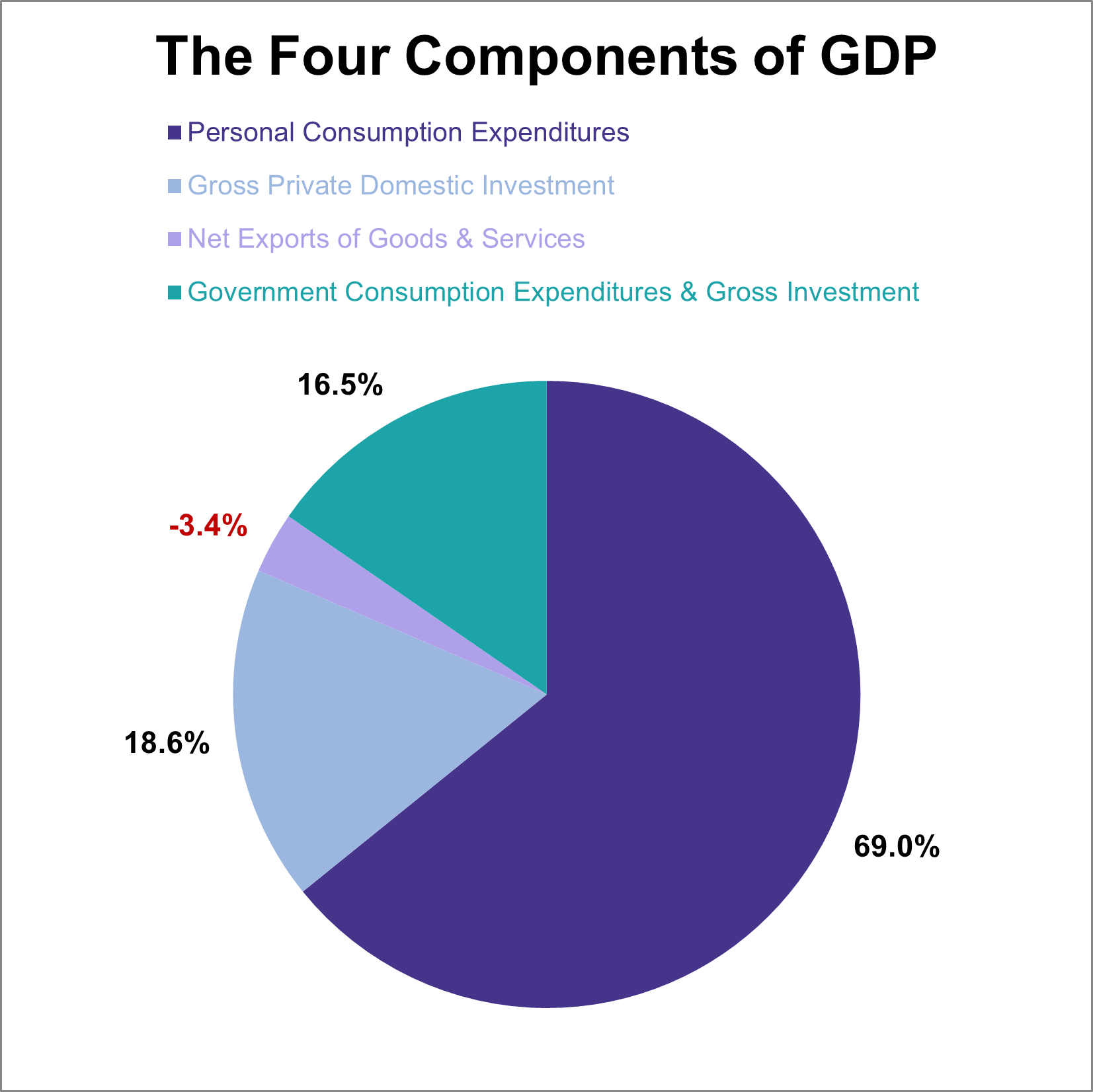
Here is the latest break down of the components as a percent of real GDP:

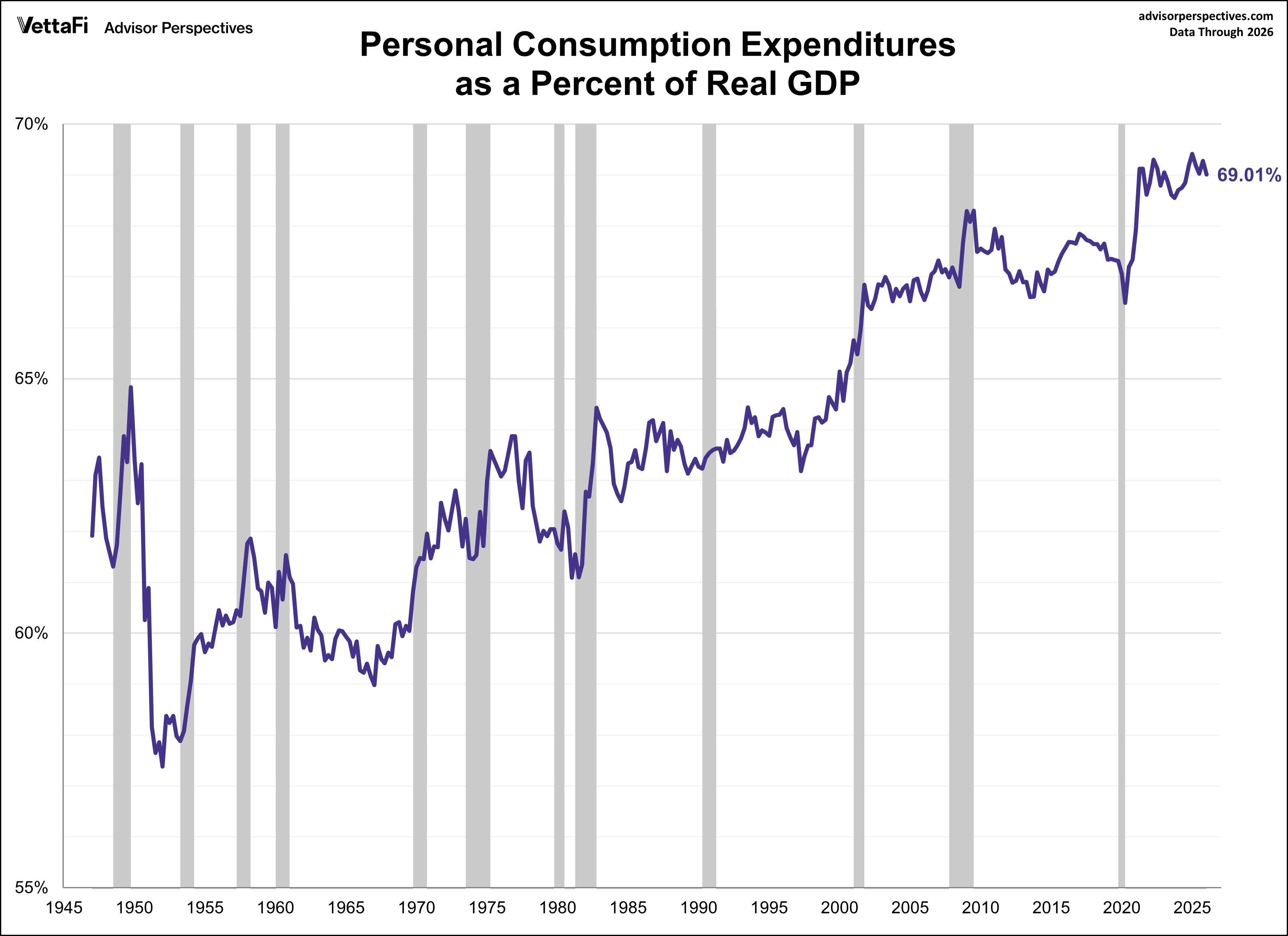
As noted earlier, the personal consumption expenditures (PCE) component has demonstrated the strongest and most consistent correlation with real GDP. When PCE is positive, GDP is typically positive as well, and vice versa. Over time, PCE's share of GDP has grown, reflecting its increasing role in the economy. The chart below provides a snapshot of the PCE-to-GDP ratio since the inception of quarterly GDP data in 1947. The ratio currently stands at 69.24%, just below its all-time high from Q1 2025 (69.41%).

GDP Components and Recessions
Let's conclude with a look at how the four GDP components behave inversely during recessions. PCE and GPDI typically rise as a share of GDP, while GCE and NEGS tend to decline during recessions. The chart below uses different vertical axes—PCE on the left and GPDI, GCE, and NEGS on the right—to emphasize these frequent inverse correlations.

Other GDP updates: Latest GDP Update and Real GDP Per Capita.
Read more updates by Jen Nash