For the first time in four years, companies in emerging markets are beating profit estimates, giving investors a fresh reason to believe the bull market is just getting started.
On Monday, the index returned to record highs, eclipsing the previous peak hit before the war started in Iran. Yet, when compared with the US market, emerging-market shares screen as cheaper than at the start of the war, reinforcing the case for investors to add exposure.
Emerging-market assets were little changed on Tuesday as traders weighed the recent optimism toward the asset class against a firmer US dollar and thinner trading volumes due to holidays in major markets.
Investors are pouring cash into emerging-market funds at a record pace as momentum builds for a rotation out of US assets.
Emerging-market stocks posted a strong start to 2026, following a $7.2 trillion annual rally, as Asia’s expanding role in artificial intelligence lifted Chinese technology shares to their biggest gains since September and pushed benchmarks in South Korea and Taiwan to record highs.
Emerging markets are poised to start 2026 as a favored trade on Wall Street, with money managers betting a multi-year cycle of investment inflows is underway.
Investors are gravitating to dollar bonds to ride the rally in emerging-markets, and have poured the most money in two years into a fund tracking the asset class.
The extra yield investors demand to own dollar bonds of emerging market sovereigns rather than US Treasuries has shrunk to the least in seven years — and the rally is set to run further.
Emerging-market funds are pivoting to capture the artificial intelligence craze, with some investors predicting that booming technology spending will drive returns for years to come.
Semiconductor stocks sent the emerging-market equity benchmark lower as US President Donald Trump’s threat to raise tariffs on the sector and an investigation into a theft of trade secrets at Taiwan Semiconductor Manufacturing Co. spooked investors. Developing currencies fluctuated.
Emerging-market stocks rose for a second day, with the benchmark gauge heading for a three-week high amid optimism over corporate earnings.
Emerging-market stocks declined for a second day and currencies halted a four-day rally as concerns grew that China’s deflation is spreading to its consumer economy and Donald Trump’s tariffs threaten US growth.
Emerging markets-focused investors have had little to celebrate over the past year.
Price action in some of the world’s most risk-sensitive assets is signaling concern that the Federal Reserve’s decision to begin lowering interest rates may have been premature — or unsustainable.
Direxion Funds has launched two exchange-traded products that focus on a single emerging-market stock — Taiwan Semiconductor Manufacturing Co. — allowing investors to make outsized bullish bets on it or take positions against the direction of the market.
Emerging-market stocks are trading at the steepest discount to US equities since the Covid-19 panic in March 2020 as skittish investors look elsewhere for growth opportunities.
The benchmark indexes for emerging-market equities and currencies, respectively, moved in opposite directions Monday, deepening a trend that emerged last week, when their short-term correlation was interrupted for the first time in 21 years.
Some of the world’s biggest money managers are searching for the next wave of artificial intelligence winners beyond the US.
An emerging-market money manager who is outperforming 99% of his peers says equity investors can make money in 2024 whether the Federal Reserve cuts interest rates or not, by focusing on countries undergoing economic transformations.
Emerging-market currencies erased their Friday gains and were poised for a third week of declines as a stronger-than-expected US jobs report underscored global interest rates could remain higher for longer.
Investors hammered Chinese assets and those of developing nations relying on its sustained growth a day after US President Joe Biden described the country’s economic woes as a “ticking time bomb.”
Investors in emerging markets are shifting to stocks from bonds as they prepare for the world after monetary tightening.
The cost of insuring emerging-market nations against default fell to the lowest in nearly a year as the dollar weakens and investors bet that less aggressive US tightening will bring relief to developing borrowers.
Emerging-market stocks extended their lead over US shares in the early days of the new year, with the equity benchmark rising to a six-month high against the S&P 500 Index.
Emerging-market central banks face a Catch-22 where plunging economic growth means they can’t keep monetary conditions tight, but elevated inflation doesn’t allow them to halt rate hikes either.
November has given a glimpse of the outperformance that emerging markets can deliver in the post-stimulus world as the maturing phase of Federal Reserve tightening focuses investors’ minds on the opportunities beyond.
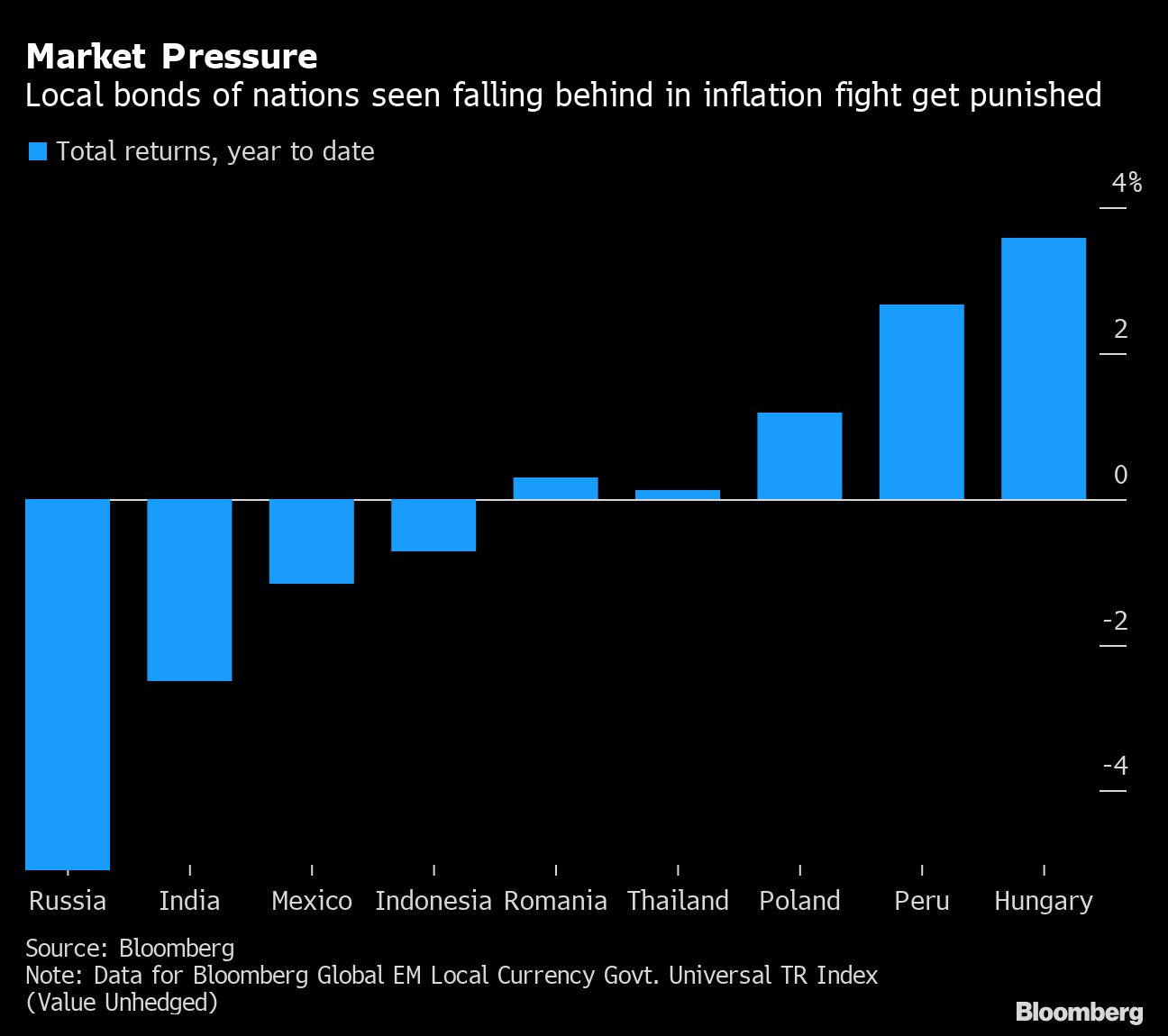
Some of this year’s worst-performing emerging markets will get another chance to lure back bond investors after their first round of aggressive rate hikes failed to contain inflation.